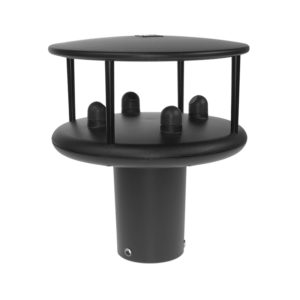
200-05305
Air Quality Wind Monitor
The 200-05305 Wind Monitor-AQ is a high resolution wind sensor designed specifically for air quality applications. It combines simple, corrosion-resistant construction with low threshold, fast response and excellent fidelity.
The 200-05305 Wind Monitor-AQ is a high resolution wind sensor designed specifically for air quality applications. It combines simple, corrosion-resistant construction with low threshold, fast response and excellent fidelity.
The Wind Monitor-AQ meets the requirements of the following regulatory agencies:
-
- U.S. Environmental Protection Agency - Ambient Monitoring Guidelines for Prevention of Significant Deterioration (PSD).
- U.S. Nuclear Regulatory Agency - NRC Regulatory Guide 1.23 Meteorological Programs in Support of Nuclear Power Plants.
- American Nuclear Society - Standard for Determining Meteorological Information at Power Plants.
Wind speed is sensed by a lightweight, carbon fiber thermoplastic (CFT), helicoid propeller. Propeller rotation produces an AC sine wave voltage signal with frequency directly proportional to wind speed. Slip rings and brushes are not used, resulting in improved reliability and lower cost. The signal is available as a raw output, voltage output or current output, depending on model chosen.
The wind direction sensor is a lightweight vane with performance characteristics that assure excellent fidelity in fluctuating wind conditions. Vane position is sensed by a precision potentiometer. With a known excitation voltage applied to the potentiometer, the output signal is directly proportional to azimuth angle. The signal is available as a raw output (in which case a regulated excitation voltage must be supplied by the monitoring equipment), or as a voltage output or current output, depending on model chosen.
The instrument body is UV stabilized plastic with stainless steel and anodized aluminum fittings. Precision grade, stainless steel ball bearings are used throughout. Transient protection and cable terminations are located in a convenient junction box on the mounting post (cable sold separately). The instrument mounts on a standard one-inch IPS pipe with an outside diameter of 34 mm (1.34").
Tariff Policy
Import Duty / Tariff
Line Item 900-Tariff will be added to this product as a separate charge rather than being incorporated into the list price. This policy allows us to adjust to current conditions at a time when tariff charges are fluctuating.